


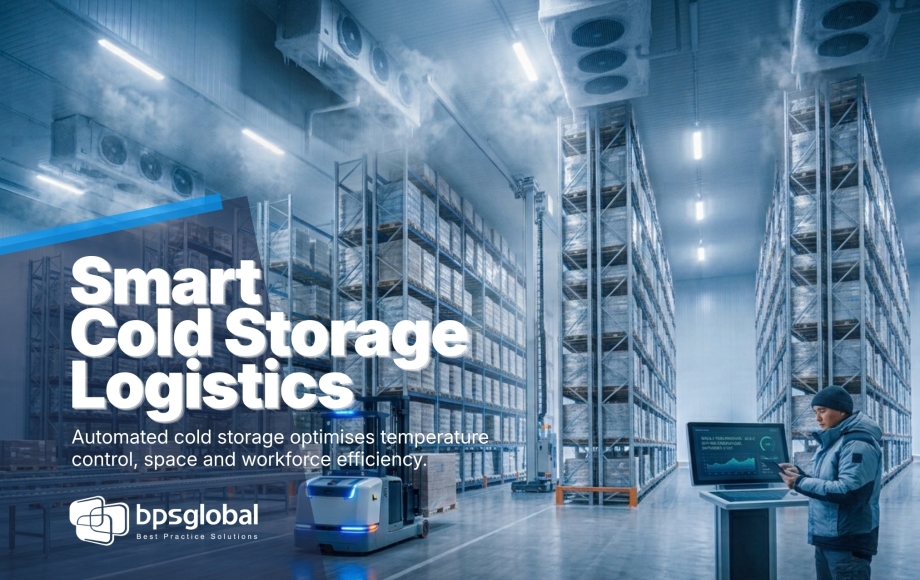
For cold chain warehousing, the core challenge goes beyond simply cooling an enclosed space to a designated temperature. It lies in ensuring seamless operations while maintaining strict thermal consistency. From personnel entry and exit to material handling, picking and handovers, even subtle operational changes can trigger temperature fluctuations.
High dispatch frequencies and staff turnover often amplify operational risks. How can operators safeguard occupational safety in extreme cold, lock in refrigerated air to prevent energy waste, and maximise storage and handling efficiency within a finite footprint? This is precisely why modern cold chain warehousing is embracing automated transformation.
The Difference Between Cold Chain and Conventional Warehousing
Conventional warehouse automation typically focuses on accelerating material handling, picking and throughput speeds. In contrast, cold chain upgrades carry an uncompromising core requirement: precise temperature control.
- Restricted Manual Operations: In low-temperature environments, workers must wear heavy thermal gear. Operational efficiency and physical stamina are severely constrained, raising occupational safety risks.
- Stringent Cargo Quality Standards: Temperature-sensitive goods, such as food and pharmaceuticals, demand strict adherence to specified thermal zones throughout storage and transport, leaving zero room for error.
As a result, cold chain automation cannot simply mirror conventional warehouse strategies. Equipment must operate reliably in low temperatures, and the entire workflow — from inbound receiving, storage and picking to outbound dispatch —requires systematic end-to-end planning with thermal insulation and multi-temperature zone isolation.
Cold Storage Automation: Balancing Manpower Management and Energy Efficiency
The most significant value of cold storage automation lies in dramatically reducing the frequency of personnel entering and leaving refrigerated and frozen zones.
In ambient warehouses, foot traffic has a negligible impact on the environment. In cold storage, however, every door opening causes a rapid loss of cold air. When personnel, forklifts, and goods move in and out frequently, refrigeration systems must run at high capacity continuously to replenish lost cold air, driving up energy consumption and utility bills.
This highlights the core advantage of deploying automation in cold storage: utilising conveyor systems, vision-guided Automated Guided Vehicles (AGVs/AMRs), and Automated Storage and Retrieval Systems (AS/RS) significantly reduces human foot traffic inside cold zones. This locks in cold air, maintains thermal stability, lightens refrigeration loads, and effectively controls operational costs at the source.
Driven by High Costs, Cold Chain Storage Demands "High-Density Storage"
Beyond temperature and manpower challenges, storage density and space utilisation represent another critical test for cold chain facilities.
Cold storage construction and operating costs far exceed those of ambient facilities. Allocating premium low-temperature real estate to aisles, manual workstations or equipment space heavily dilutes actual storage capacity. For land-scarce, high-cost markets like Hong Kong, expanding physical footprint is impractical. Cold storage automation delivers a solution by "growing vertically":
- Maximising Vertical Space: Integrating AS/RS, mobile racking, and vertical carousel storage systems breaks traditional flat layout constraints to achieve high-density storage.
- Optimising Traffic Flow and Temperature Zones: Efficient space utilisation doubles storage capacity within a footprint while enabling systematic layout planning for logistics flow and multi-temperature zoning, achieving a seamless match between space and workflow.
BPS Global Case Study: A One-Stop Solution to Low Temperature, Space, and Manpower Challenges
BPS Global Group designed and implemented a 140,000 sq. ft. automated medical logistics distribution centre for a prominent pharmaceutical outsourcing provider in Hong Kong. Fully compliant with GMP standards and Department of Health guidelines, the facility features a 6,000 sq. ft. temperature-controlled cold room equipped with 24/7 real-time monitoring.
The project was engineered around end-to-end logistics flow:
- Seamless Equipment Integration: Deployed vertical carousel systems, vision-guided AGVs, mobile racking and automated conveyors to precisely connect various operational zones.
- Workflow Optimisation: Minimised traditional manual handling, significantly boosting cargo throughput and retrieval efficiency inside the cold room.
- Substantial Performance Gains: Enabled high-efficiency batch picking and accurate packaging. The vertical carousels and mobile racking dramatically shortened cycle times, elevated picking accuracy, reduced labor dependence, and effectively contained long-term operating costs.
Cold Chain Warehousing Is Far More Than Simply "Cooling Down" a Facility
The fundamental difference between cold chain and conventional warehousing lies in the need to balance temperature control with extreme operational environments in every detail. Storage space, logistics traffic, manpower allocation, energy consumption, and temperature stability are interconnected.
With over 30 years of expertise in cold chain logistics, cold storage engineering and warehouse automation, BPS Global Group delivers end-to-end services from master planning and engineering design to software/hardware integration and turnkey deployment. Facing complex operational constraints, BPS Global tailors optimised cold storage automation solutions grounded in real business needs, helping enterprises maximise efficiency while keeping operating costs under firm control.